Early clot removal helped mild strokes from big blockages recover
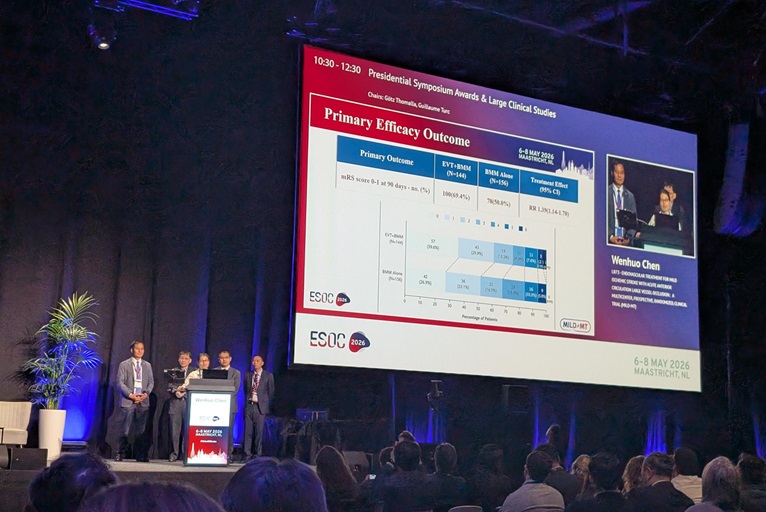
In the MILD-MT trial, thrombectomy within 24 hours left 69.4% of people with mild large-vessel strokes free of meaningful disability, against 50.0% on medicines alone.
Contents
- What is a mild large-vessel stroke?
- Who took part in MILD-MT?
- What did the trial find?
- Did early clot removal stop people getting worse?
- How risky was the procedure?
- What does the result mean in plain numbers?
- How does this fit with LATE-MT and other trials?
- What are the trial's limits?
- What could change for stroke care in the UK?
- What should patients and families ask?
Removing the clot straight away helped more people with a mild stroke caused by a blocked large brain artery make a near-complete recovery, in the MILD-MT trial from China. At 90 days, 69.4% of patients who had thrombectomy plus usual medical care had no symptoms or no meaningful disability, against 50.0% of those given medical care alone. The results were published in the New England Journal of Medicine on 23 October 2026.
There was a catch. Serious complications from the procedure itself hit 19 of the 144 people who had it, or 13.2%.
The trial goes after one of the grey areas in stroke care. Thrombectomy is standard for large-vessel strokes that cause obvious disability. When the same kind of blockage causes only mild symptoms, many hospitals give clot-busting drugs or antiplatelets and watch, ready to step in if the person gets worse. MILD-MT tested whether stepping in early is better.
What is a mild large-vessel stroke?
Most strokes are caused by a clot blocking an artery to the brain. When the clot sits in one of the big arteries at the base of the brain, such as the internal carotid artery or the first part of the middle cerebral artery, doctors call it a large-vessel occlusion. These blockages usually cause severe strokes.
Some people are luckier at first. Smaller side vessels, known as collaterals, can keep blood flowing to the threatened area for a while. The person might have a weak hand, slightly slurred speech or a drooping face, and score under 6 on the National Institutes of Health Stroke Scale (NIHSS), the 42-point checklist stroke teams use to grade severity.
The trouble is that collaterals can fail. A mild stroke can turn into a disabling one over hours or days, a problem doctors call early neurological deterioration. Speaking when the results were first presented in May, Wenhuo Chen of Fujian Medical University Union Hospital said mild strokes make up as much as 10% of large-vessel strokes, but earlier thrombectomy trials included very few of them, as TCTMD reported.
Who took part in MILD-MT?
MILD-MT (NCT06179017) ran at 26 hospitals in China. The registry lists Zhangzhou Municipal Hospital as the lead sponsor, with enrolment from February 2024 to January 2026. The trial randomised 304 people. The main analysis covered 300 of them, 144 assigned to thrombectomy and 156 to medical management alone.
To get in, patients had to meet several conditions:
- a blockage in the internal carotid artery or the M1 or M2 segment of the middle cerebral artery, confirmed on a CT or MR angiogram
- an NIHSS score below 6 at randomisation, including people who scored higher at onset but improved
- treatment possible within 24 hours of symptom onset or of when they were last seen well
- a perfusion scan showing an infarct core (tissue already lost) of 50 mL or less and at-risk tissue of at least 50 mL more than that
- age 18 to 80, with no disability before the stroke
That fourth rule is the important one. The investigators were not treating every mild large-vessel stroke. They picked people whose scans showed a lot of brain still in danger, the group most likely to deteriorate.
The typical patient was about 67 years old, and around three quarters were men. The median NIHSS score was 4. In 58% of patients the blockage was linked to intracranial atherosclerosis, a build-up of fatty plaque inside the brain's own arteries, which is more common in East Asian populations than in Europe.
The trial was open-label, so patients and doctors knew who had the procedure. The people scoring the 90-day outcomes did not. Our guide to open-label and blinded trials explains how outcome blinding protects results for a procedure that cannot be disguised.
What did the trial find?
The main measure was the share of people with a modified Rankin scale (mRS) score of 0 or 1 at 90 days. A score of 0 means no symptoms at all. A score of 1 means some symptoms but no real effect on daily life.
| Outcome at 90 days | Thrombectomy plus medical care (144) | Medical care alone (156) |
|---|---|---|
| Excellent recovery (mRS 0 to 1) | 69.4% | 50.0% |
| Independent (mRS 0 to 2) | 82.6% | 66.0% |
| Barthel Index of 95 to 100 (little or no help with daily tasks) | 83.9% | 69.9% |
| Deaths | 1 patient | 0 patients |
The NEJM paper gives an odds ratio of 2.32 for the main result (95% CI 1.41 to 3.81, P<0.001). When the data were presented at the European Stroke Organisation Conference (ESOC) in Maastricht in May, the team gave it as a risk ratio of 1.39 (95% CI 1.14 to 1.70). The two figures describe the same gap in different ways. The mRS 0 to 2 and Barthel figures come from the conference presentation, as reported by TCTMD and NeuroNews International.
The benefit looked consistent across the subgroups the investigators checked.
Did early clot removal stop people getting worse?
Partly. Deterioration within the first 24 hours was 6.3% after thrombectomy and 10.9% with medical care alone, a gap that was not statistically significant. By day 7 the difference was clear: 13.9% against 31.4% (risk ratio 0.48, 95% CI 0.29 to 0.78), according to TCTMD's report from ESOC.
Read that second number again. Almost one in three people in the medical care group got worse in the first week, despite starting with a mild stroke. That is the risk the watch-and-wait approach carries, and it is the reason the investigators chose perfusion scans to find people with large areas of brain at risk.
The presenters also reported that the artery was reopened in 94% of patients who had the procedure, at high-volume centres.
How risky was the procedure?
This is the part that will shape how doctors use the result. The NEJM abstract describes the rate of serious procedural complications as high.
| Safety measure | Thrombectomy plus medical care | Medical care alone |
|---|---|---|
| Symptomatic brain bleed within 48 hours | 3 patients (2.1%) | 3 patients (1.9%) |
| Any brain bleed on scans | 18.9% | 6.8% |
| Serious procedure-related complications | 19 patients (13.2%) | Not applicable |
| Deaths at 90 days | 1 | 0 |
The brain bleeds that cause symptoms, the ones that usually worry stroke doctors most, were no more common with thrombectomy. Bleeds seen only on scans were nearly three times as frequent. The abstract does not break down the 19 serious procedural complications by type, so we cannot say how many were artery tears, new clots in other vessels or problems at the groin or wrist puncture site.
What does the result mean in plain numbers?
Percentages are easier to judge as people. Here is a worked example using the trial's own figures.
Picture 100 people like those in MILD-MT who have thrombectomy, and 100 who get medical care alone. After 90 days, about 69 in the thrombectomy group would have no symptoms or no meaningful disability. In the medical care group the figure would be 50.
That is 19.4 extra excellent recoveries per 100 people treated (69.4 minus 50.0). Divide 100 by 19.4 and you get about 5.2. So, roughly, for every five people like these who have the procedure, one more makes a near-complete recovery than would have done without it.
Now the cost. In the same 100 people having thrombectomy, about 13 would have a serious complication from the procedure (13.2%). About 12 more would show some bleeding on a scan than in the medical care group (18.9 minus 6.8 = 12.1), although symptomatic bleeds were level.
These are not separate groups. Someone can have a procedural complication and still end up with a good mRS score, and the 90-day outcomes already include any harm the complications caused. Our guide to reading trial results and absolute risk walks through these calculations in more detail.
How does this fit with LATE-MT and other trials?
MILD-MT appeared in the NEJM on the same day as LATE-MT, another Chinese trial that tested thrombectomy 24 to 72 hours after a more severe large-vessel stroke. Both pushed thrombectomy into groups that guidelines have mostly left out. Both also found the procedure helped recovery while carrying real risks. Some investigators worked on both trials, including Jianmin Liu of Changhai Hospital in Shanghai and Craig Anderson of the George Institute for Global Health in Sydney.
Before MILD-MT, the evidence on mild large-vessel stroke came mostly from observational studies, and those gave mixed answers. A French randomised trial, MOSTE (NCT03796468), led by University Hospital Montpellier, compares immediate thrombectomy with medical care plus rescue thrombectomy if the patient worsens in people with an NIHSS of 5 or below. Its registry entry gave an estimated primary completion date of July 2025, and we could not find published results when we checked. MOSTE did not require a perfusion scan showing a large area at risk, so its answer may differ.
Jelle Demeestere of University Hospitals Leuven, who was not involved in MILD-MT, told TCTMD that many large centres had already started treating milder patients. "If we see patients with mild stroke, don't wait and see because they have a high chance of deteriorating and just go for thrombectomy," he said. He added that confirmation from other studies would still help.
What are the trial's limits?
Several points should temper the headline.
The trial was run only in China, at centres with fast access to perfusion imaging and experienced teams. More than half of the strokes were linked to intracranial atherosclerosis, a different mix of causes from many UK and European stroke units. Whether the same benefit appears elsewhere is unknown.
The selection was strict. People had to be 80 or under, fully independent before the stroke, and have a perfusion scan showing a mismatch of at least 50 mL. A mild stroke without that scan pattern was not tested.
The procedural complication rate of 13.2% may depend on the operator and the hospital. It could be lower in some services and higher in others. Patients knew which treatment they got, although outcome assessors did not.
The funders listed by TCTMD include a device maker, MicroPort NeurTech, alongside the Beijing Health Promotion Association and Fujian Medical University Union Hospital. The full NEJM paper sits behind a paywall, and this article relies on its abstract plus conference reports for the secondary results.
What could change for stroke care in the UK?
Current UK guidance does not cover these patients. The National Clinical Guideline for Stroke for the UK and Ireland, in its 2023 edition, recommends considering thrombectomy for anterior circulation strokes when a proximal large artery blockage causes "a disabling neurological deficit (NIHSS score of 6 or more)". People with an NIHSS score below 6 fall outside that wording, although stroke teams can still make individual decisions.
For later time windows the guideline already relies on perfusion imaging to find salvageable brain, and MILD-MT leans on the same tools. If guideline writers act on this trial, a likely first step would be making thrombectomy an option for mild strokes with a confirmed large-vessel blockage and a big perfusion mismatch, which would mean more CT perfusion scans in the early hours and more transfers to thrombectomy centres. That is our reading of the evidence. No UK body has announced a review.
Stroke prevention is a separate question, but people interested in what happens after a stroke may find our article on blood thinners for atrial fibrillation at intermediate stroke risk useful.
What should patients and families ask?
Stroke is an emergency whatever the symptoms. Call 999 in the UK (or your local emergency number) at the first sign of face drooping, arm weakness or speech problems, even if the symptoms seem small or start to fade. MILD-MT only helped people who reached hospital quickly enough to be scanned and treated within 24 hours.
If you or a relative has had a mild stroke and the team mentions a blocked large artery, these questions can help. Was a CT angiogram or perfusion scan done, and what did it show about the brain at risk? Is thrombectomy being considered, and if not, why not? What are the chances of getting worse over the next few days, and how will the team watch for it? Could a transfer to a thrombectomy centre help?
If you want to take part in stroke research, our guide on how to find and join a clinical trial explains how to search the registries.
This article is for information only and is not medical advice. Decisions about stroke treatment are made by the stroke team looking after you.
Frequently asked questions
What was the MILD-MT trial?
MILD-MT was a randomised trial at 26 hospitals in China. It compared thrombectomy plus medical care with medical care alone in 300 people whose stroke was mild (NIHSS below 6) but caused by a blocked large artery, with a scan showing plenty of brain still at risk. Results were published in the New England Journal of Medicine on 23 October 2026.
How much did thrombectomy help in MILD-MT?
At 90 days, 69.4% of people who had thrombectomy had no symptoms or no meaningful disability (an mRS score of 0 or 1), compared with 50.0% of those given medical care alone. That is about 19 extra excellent recoveries for every 100 people treated, or one extra for roughly every five people who have the procedure.
What are the risks of thrombectomy for a mild stroke?
Serious complications linked to the procedure affected 19 of 144 patients, or 13.2%. Bleeds seen on scans were more common after thrombectomy (18.9% against 6.8%), but bleeds that caused symptoms were not, with 3 patients in each group. One person in the thrombectomy group died during the trial and none in the comparison group.
What is an NIHSS score?
The National Institutes of Health Stroke Scale is a checklist stroke teams use to grade how severe a stroke is. It tests things like consciousness, movement, speech, vision and sensation, and gives a score from 0 to 42. A score below 6 usually means mild symptoms. UK guidance currently recommends thrombectomy mainly for scores of 6 or more.
Will the NHS offer thrombectomy for mild strokes now?
Not routinely yet. The 2023 National Clinical Guideline for Stroke for the UK and Ireland recommends thrombectomy for large-vessel strokes with an NIHSS score of 6 or more. Stroke teams can make individual decisions, and guideline writers may look at MILD-MT, but the trial was run only in China and outside results would help.
Sources
- Trial of Endovascular Therapy for Mild Stroke with Large-Vessel Occlusion (Liu J, Yi T, et al.; MILD-MT Investigators). New England Journal of Medicine, 2026-10-23
- Trial of Endovascular Therapy for Mild Stroke with Large-Vessel Occlusion (abstract, PMID 42929671). PubMed, 2026-10-23
- Endovascular Treatment for Mild Stroke With Acute Anterior Circulation Large Vessel Occlusion (MILD-MT), NCT06179017. ClinicalTrials.gov, 2026-09-24
- Trials support thrombectomy in very late time windows, milder strokes. TCTMD, 2026-05-15
- Thrombectomy shows efficacy alongside acceptable safety profile in mild LVO stroke patients. NeuroNews International, 2026-05-22
- Minor Stroke Therapy Evaluation (MOSTE), NCT03796468. ClinicalTrials.gov, 2025-07-01
- National Clinical Guideline for Stroke for the UK and Ireland: acute care. Intercollegiate Stroke Working Party, 2023-04-04
Medical disclaimer: For information only, not medical advice. Speak to a qualified healthcare professional about your care.
The Briefing
Trial results that matter, every Friday.
One email. The week's readouts, approvals and research, explained without hype.
Related reading
 Neurology
Twice-daily MS pill cuts relapses by a third against older tablet
23 October 2026
 Neurology
Asthma inhaler plus ibuprofen fails to slow early Alzheimer's
23 October 2026
 Neurology
Clot removal days after a stroke helps recovery but carries risk
23 October 2026
 Neurology
Vitamin B3 supplement fails to slow Parkinson's in a large trial
8 October 2026