Daily pill gives people with sun-induced pain more time outdoors
Phase 3 APOLLO results show bitopertin added about 12 pain-free hours in light each month and cut painful reactions by 71% in erythropoietic protoporphyria, a rare inherited condition.
Contents
For people with erythropoietic protoporphyria, a few minutes of sunshine can bring on burning pain that lasts for days. A once-daily tablet called bitopertin gave people in a phase 3 trial about 12 more hours a month in light without pain and cut painful reactions by 71%, according to topline results from Disc Medicine.
The company announced the results of the APOLLO trial on 19 October 2026 at 07:00 US Eastern time (13:00 in Madrid) and set out the details in investor slides filed with the US Securities and Exchange Commission. All key goals were met. The findings haven't yet been presented at a medical meeting or published in a journal.
The results come eight months after the US Food and Drug Administration (FDA) turned down Disc's earlier request for accelerated approval. The company now plans to resubmit its application by the end of 2026, with a decision expected by mid 2027.
What EPP is
Erythropoietic protoporphyria (EPP) is a rare inherited condition in which a substance called protoporphyrin IX (PPIX) builds up in red blood cells and plasma. PPIX is the last step before haem, the iron-containing part of haemoglobin. In EPP, a fault in the enzyme ferrochelatase, which inserts iron into PPIX, means PPIX accumulates. A closely related condition, X-linked protoporphyria (XLP), has the same effect through a different genetic route, an overactive enzyme called ALAS2.
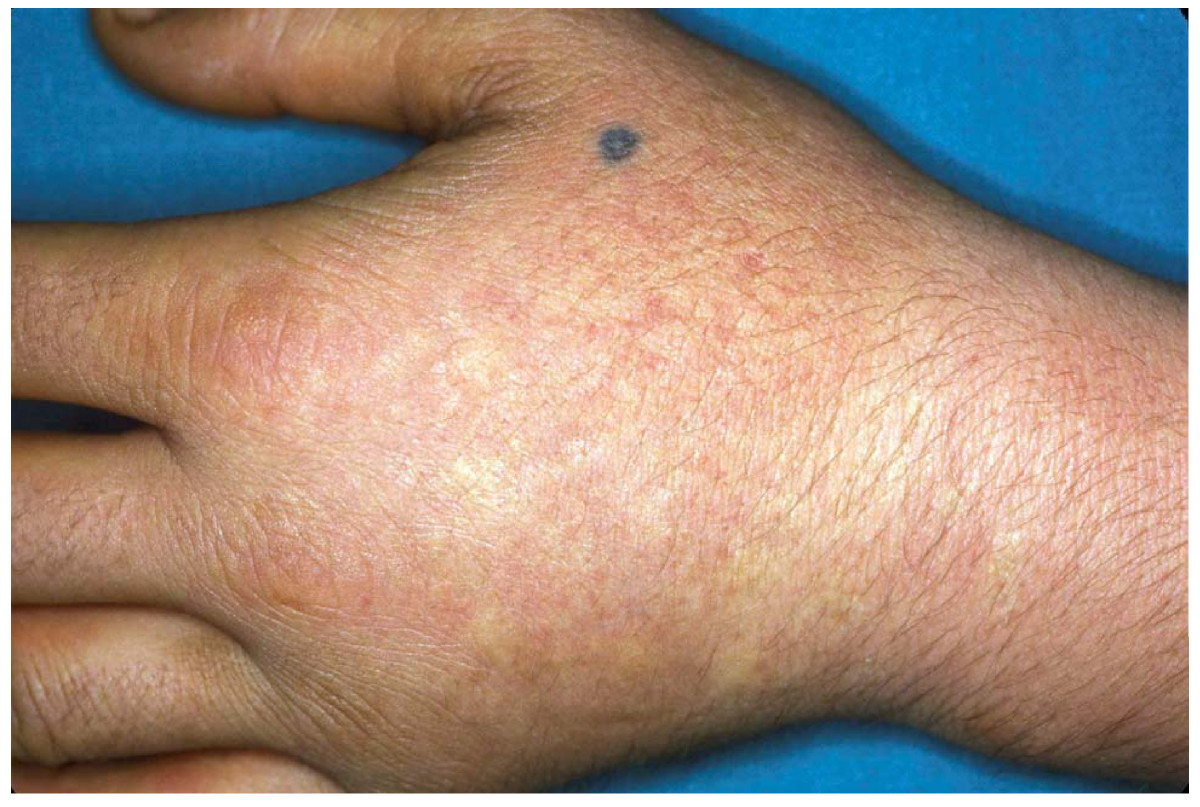
PPIX absorbs visible light, especially blue light. When it's struck by sunlight in the skin's small blood vessels, it releases energy that damages the surrounding tissue. The result is a phototoxic reaction: tingling, burning or stinging (the prodrome), followed by severe pain, swelling and redness, often on the hands and face. The photo above, from a 2009 review in the Orphanet Journal of Rare Diseases, shows an acute reaction. Unlike sunburn, the pain can come on within minutes, is often not visible, and doesn't respond well to standard painkillers.
Symptoms usually start in early childhood. Children learn to avoid the sun, and many adults organise their lives around it, using protective clothing, tinted car windows and indoor jobs. Ordinary sunscreens don't block the visible light that causes reactions, although thick zinc or titanium oxide creams can help a little. PPIX also passes through the liver, and a minority of people develop gallstones or liver damage, which can occasionally be severe enough to need a transplant.
EPP affects roughly 1 in 75,000 to 1 in 200,000 people in Europe, although estimates vary. The only approved treatment is afamelanotide (Scenesse), an implant placed under the skin every two months that darkens skin pigment and increases tolerance of light. It's approved in Europe and the US, but it requires a minor procedure every two months and access varies between countries.
How bitopertin works
Bitopertin blocks a protein called glycine transporter 1 (GlyT1). Developing red blood cells use GlyT1 to take in glycine, one of the two building blocks for the first step in making haem. Limiting glycine supply slows the whole haem production line, so less PPIX is made in the first place.
The drug was first developed by Roche to treat schizophrenia, where it was tested in more than 4,000 people before that programme was stopped for lack of effect. That history means its safety profile in people is well characterised. Disc licensed it in 2021 and repurposed it for EPP.
What happened at the FDA
In 2025, Disc applied for accelerated approval of bitopertin based on its phase 2 studies, BEACON and AURORA, which showed large falls in PPIX levels. Under that pathway, regulators can approve a drug based on a marker reasonably likely to predict clinical benefit. In February 2026, the FDA issued a complete response letter, its way of saying the application couldn't be approved in its current form. The phase 3 APOLLO trial was designed to show direct benefit on light tolerance and pain.
The APOLLO trial
APOLLO (NCT06910358) was a randomised, double-blind, placebo-controlled phase 3 trial run in the US, UK, European Union, Canada and Australia. It enrolled 183 people aged 12 and over with EPP or XLP. They were randomly assigned to bitopertin 60 mg once a day (91 people) or placebo (92 people) for six months.
The average age was 35.8 years in the bitopertin group and 38.4 in the placebo group, and teenagers aged 12 to 17 made up 15% and 22% of the groups. At the start, average PPIX levels were around 9,000 to 9,700 ng/mL, many times above normal. Participants spent less than an hour a day on average in direct light, and about half felt warning symptoms within 30 minutes of sun exposure.
The main goal was the change in PPIX in the blood after six months. The key secondary goals measured what patients experience: time spent in light without pain, the number of phototoxic reactions, and how long people could stay in sunlight before the prodrome began.
The results
PPIX levels
Bitopertin reduced PPIX by 41.4% more than placebo after six months (p<0.0001). That confirms the drug does what it's designed to do at a biological level.
More time in light
In the sixth month, people on bitopertin gained 12.2 hours of time in light without pain compared with placebo (p=0.0010). At baseline, the groups were averaging 11.4 and 10.7 hours a month. Cumulative time in light without pain over the whole six months was also significantly higher on bitopertin (p<0.0001).
Twelve extra hours a month may sound modest, but for people who start with around 11 hours, it represents roughly a doubling. In practice, that could mean being able to walk a child to school, sit in a garden, or attend an outdoor event without paying for it with days of pain.
Fewer phototoxic reactions
The rate of phototoxic reactions was 71% lower on bitopertin than on placebo (incidence rate ratio 0.29, p<0.0001). Each of these reactions can mean days of pain, so a fall of this size could be meaningful for daily life.
Longer before warning signs
In adults, who took part in weekly structured sunlight challenges, bitopertin increased the average time before the prodrome began by 56 minutes compared with placebo (p=0.0077).
How patients felt
On two global ratings, one asking people how much they had changed since starting treatment and another asking how severe their EPP was, bitopertin scored significantly better than placebo (p<0.0001 for both).
Side effects
Side effects were reported by 85% of people on bitopertin and 75% on placebo. Most were mild or moderate:
- Dizziness: 50% on bitopertin, 11% on placebo. Disc says it was transient.
- Nausea: 20% against 11%.
- Fatigue: 17% against 7%.
- Headache: 17% against 21%.
Grade 3 (severe) side effects affected 7% on bitopertin and 3% on placebo. Serious side effects were reported in 1% and 2%. No one stopped treatment because of side effects. Of those who finished APOLLO, 97% chose to continue on bitopertin in the open-label HELIOS extension study, a sign that most participants felt the benefits outweighed the drawbacks.
Dizziness affecting half of patients is notable. It will be important to see more detail about when it starts, how long it lasts and whether it affects driving or work. Because bitopertin lowers haem production, doctors will also want to see full data on haemoglobin and iron levels, since anaemia is a theoretical concern with long-term use.
Limitations
- Topline data only. The figures come from a company announcement and investor slides. Full results haven't been peer reviewed.
- Six months. The trial ran through a single treatment period; the HELIOS extension will show whether benefits last and whether new side effects appear.
- Self-reported light exposure. Time in light and phototoxic reactions were recorded by participants, which is unavoidable in EPP but can be influenced by expectations. Blinding helps limit this, although the high rate of dizziness on bitopertin could have hinted to some participants which group they were in.
- Liver outcomes. The trial wasn't designed to show whether lowering PPIX protects the liver. A separate study (NCT07123363) is looking at this in people with liver involvement.
- Children under 12. They weren't included, even though symptoms often begin in early childhood.
What happens next
Disc plans to resubmit its application to the FDA by the end of 2026, now backed by phase 3 evidence of clinical benefit, and expects a decision by mid 2027. The company has said it will present the full APOLLO data at an upcoming medical meeting. No timetable for applications in Europe or the UK has been announced.
If approved, bitopertin would be the first oral treatment for EPP and the first designed to reduce the amount of PPIX the body makes. Afamelanotide works differently, by increasing skin pigment, so the two could in principle be used in different people or even together, although there's no data on combining them.
For people with EPP, APOLLO is the first large controlled trial to show that a tablet can extend safe time in light and reduce painful reactions. People interested in the HELIOS extension or future trials can ask their dermatologist or porphyria specialist, or contact patient groups such as the British Porphyria Association, the Global Porphyria Advocacy Coalition or the American Porphyria Foundation.
Frequently asked questions
What is erythropoietic protoporphyria?
EPP is a rare inherited condition in which protoporphyrin IX builds up in the blood. When light hits the skin, it causes severe burning pain, swelling and redness that can last for days.
How does bitopertin work?
Bitopertin blocks glycine transporter 1, which developing red blood cells use to take in glycine, a building block of haem. Less glycine means less protoporphyrin IX is made.
What did the APOLLO trial show?
In 183 people aged 12 and over, bitopertin lowered protoporphyrin IX by 41.4% more than placebo, added 12.2 hours of pain-free time in light in month six and cut phototoxic reactions by 71%.
What are the side effects of bitopertin?
Dizziness affected 50% on bitopertin against 11% on placebo and was described as transient. Nausea and fatigue were also more common. No one stopped treatment because of side effects.
When could bitopertin be available?
Disc Medicine plans to resubmit its US application by the end of 2026, with an FDA decision expected by mid 2027. No UK or European timetable has been announced.
Sources
- Disc Medicine investor presentation: APOLLO topline results (Exhibit 99.2, Form 8-K). US Securities and Exchange Commission, 2026-10-19
- NCT06910358 on ClinicalTrials.gov. ClinicalTrials.gov
- NCT05883748 on ClinicalTrials.gov. ClinicalTrials.gov
- Lecha M, Puy H, Deybach JC. Erythropoietic protoporphyria. Orphanet Journal of Rare Diseases, 2009
Medical disclaimer: For information only, not medical advice. Speak to a qualified healthcare professional about your care.
The Briefing
Trial results that matter, every Friday.
One email. The week's readouts, approvals and research, explained without hype.
Related reading
 Rare Diseases
Sickle cell tablet lifts blood counts but pain crises barely move
22 October 2026
 Rare Diseases
Weekly atacicept keeps kidney function steady in IgA nephropathy
22 October 2026
 Rare Diseases
One-off Huntington's gene therapy still slows decline at 4 years
29 September 2026
 Rare Diseases
Gene-silencing drug works in rare ALS that strikes young people
22 September 2026