Smarter artery scans after heart attack cut repeat events by 38%
In the AIR-STEMI trial, software that measures blood flow from routine angiograms meant fewer stents, fewer complications and fewer repeat heart events than judging by eye.
Contents
After a major heart attack, using a computer to work out which other narrowed arteries really limit blood flow, instead of judging by eye, cut repeat heart problems by about a third. That was the main result of the AIR-STEMI trial, presented on 29 August 2026 at ESC Congress in Munich and published at the same time in the New England Journal of Medicine.
The approach also meant fewer stents, less X-ray dye and fewer complications.
The problem the trial tackled
A STEMI (ST-segment elevation myocardial infarction) is the most serious type of heart attack, where a coronary artery is fully or almost fully blocked. Doctors open the blocked artery, called the culprit, with a balloon and a stent.
The European Society of Cardiology (ESC) says almost half of STEMI patients also have narrowings in other coronary arteries. This is called multivessel disease. ESC guidelines recommend treating these non-culprit narrowings too, known as complete revascularisation.
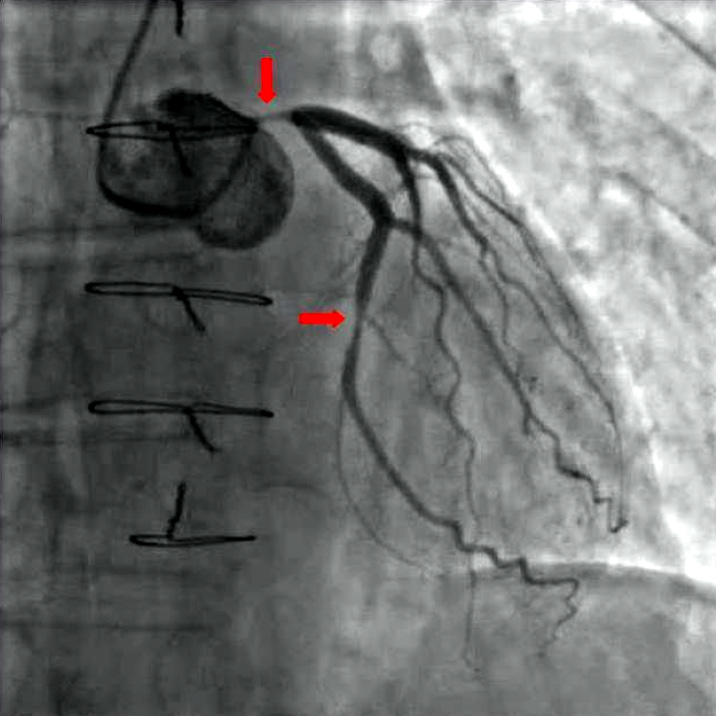
The hard part is deciding which narrowings need a stent. Most hospitals decide from the angiogram, the X-ray video of dye flowing through the arteries. Lead investigator Associate Professor Simone Biscaglia of University Hospital of Ferrara pointed out the weakness of this: "Traditional coronary angiography provides a two-dimensional picture of narrowed vessels, which is subjective since it is interpreted by the human eye."
A narrowing that looks severe may not reduce blood flow much, and one that looks mild may matter more than it seems.
What functional coronary angiography does
Functional coronary angiography uses the angiogram images already taken during the emergency procedure. Software rebuilds the artery in three dimensions and estimates how much the narrowing restricts flow. The result is an angiography-derived fractional flow reserve, or FFR.
FFR is a ratio. A value of 1.0 means no drop in pressure across the narrowing. In AIR-STEMI:
- narrowings with an FFR of 0.80 or less were treated with a stent
- narrowings above 0.80 were left alone
The standard method of measuring FFR needs a pressure wire threaded into the artery and a drug to widen the vessels. The software method needs neither. In the trial, FFR analysis was done centrally in a core laboratory.
Who took part
AIR-STEMI was an investigator-led trial at 21 centres in Italy and Pakistan. It enrolled 1,823 people with STEMI and multivessel disease whose culprit artery had already been successfully opened. The median age was 66, and 24% were women.
Patients were randomly assigned to have their other narrowings treated based on either:
- functional coronary angiography, with stents only where FFR was 0.80 or less
- conventional angiography, with stents for any narrowing judged at least 50% by eye
The results
The main endpoint combined death from any cause, heart attack, stroke and repeat procedures to unblock an artery because of reduced blood supply. Median follow-up was 17.9 months.
| Outcome | Functional angiography | Conventional angiography |
|---|---|---|
| Main combined endpoint | 8.9% | 13.7% |
| Death from any cause | 3.9% | 5.1% |
| Kidney injury from dye or major bleeding | 4.6% | 7.1% |
| Share of non-culprit vessels stented | 51.9% | 94.9% |
The hazard ratio for the main endpoint was 0.62, a 38% lower risk. For the safety endpoint, the hazard ratio was 0.63, a 37% lower risk.
Heart attacks, both those linked to the procedure and those occurring later, and repeat procedures were all significantly reduced. The difference in deaths was not statistically significant (hazard ratio 0.77, with a confidence interval running from 0.50 to 1.20), so the trial does not show that the approach saves lives.
A simple way to read the main result: in 1,000 people treated with the conventional approach, about 137 had one of the main events over roughly a year and a half. With the functional approach, about 89 did. That is around 48 fewer events per 1,000 patients, from the trial's reported percentages.
Why fewer stents led to fewer problems
In the functional group, only about half of the other narrowed vessels got a stent, against almost all in the conventional group. According to the ESC, this meant fewer procedures, fewer treated vessels, shorter treated segments and less dye.
Less dye lowers the risk of kidney injury. Fewer and shorter stents mean less metal in the arteries, which may reduce later blockages within the stent and procedure-related heart damage. The trial was not designed to separate out which of these explains the benefit.
Biscaglia summed up the aim as "treating the lesions that matter, while avoiding unnecessary PCI in lesions that do not appear to limit blood flow."
Points to weigh
- Where it was run. All 21 centres were in Italy and Pakistan. Results may differ in health systems with different patient groups or catheter lab practice.
- The comparison. The control arm stented almost every narrowing of 50% or more. Some hospitals already use pressure wires to guide these decisions, and AIR-STEMI did not compare against that.
- Funding and links. The trial was supported by the University Hospital of Ferrara and Consorzio Futuro in Ricerca, which received unrestricted funding from Sahajanand Medical Technologies and Siemens Healthineers. Two imaging firms provided software licences. Biscaglia reported fees from several of these companies.
- Follow-up. Median follow-up of under 18 months is fairly short for heart outcomes.
What it means for patients
If you have had a STEMI and been told other arteries are narrowed, the question of which ones to stent is a real decision. AIR-STEMI suggests a software assessment of the angiogram can guide that choice and may spare some people stents they do not need. Availability of the software varies between hospitals.
This article explains research findings and is not medical advice. Ask your cardiology team about your own treatment.
Frequently asked questions
What is functional coronary angiography?
It uses software to rebuild the coronary arteries in 3D from routine angiogram images and estimate how much each narrowing limits blood flow. The result, an angiography-derived FFR, guides which narrowings need a stent, without a pressure wire. Standard FFR needs a wire threaded into the artery and a drug to widen the vessels, so the software approach can be quicker to use during an emergency procedure.
What did AIR-STEMI find?
In 1,823 people with STEMI and multivessel disease, the combined rate of death, heart attack, stroke or repeat procedures was 8.9% with functional angiography against 13.7% with conventional angiography, over a median of 17.9 months.
Did it reduce deaths?
No significant difference was found. Deaths were 3.9% against 5.1%, but the trial cannot show that the approach saves lives. The benefit came mainly from fewer heart attacks, including those linked to the procedure, and fewer repeat procedures to reopen arteries.
Why did fewer stents help?
Only 51.9% of other narrowed vessels were stented in the functional group against 94.9% in the conventional group. That meant less dye and fewer procedures, and kidney injury or major bleeding fell to 4.6% from 7.1%.
Is this available in the UK?
Angiography-derived FFR software exists, but its use varies between hospitals. Ask your cardiology team how decisions about extra stents are made where you are treated. AIR-STEMI was run in Italy and Pakistan, and its results have not yet led to changes in UK guidance that we could find.
Sources
- Positive data revealed for patients with a heart attack and multivessel disease. European Society of Cardiology, 2026-08-29
- AIR-STEMI trial: Functional Coronary Angiography in STEMI. New England Journal of Medicine, 2026-08-29
- 2023 ESC Guidelines for the management of acute coronary syndromes. European Heart Journal
Medical disclaimer: For information only, not medical advice. Speak to a qualified healthcare professional about your care.
The Briefing
Trial results that matter, every Friday.
One email. The week's readouts, approvals and research, explained without hype.
Related reading
 Cardiology
Lung artery nerve procedure halves worsening in heart failure
30 August 2026
 Cardiology
Fixing a leaky heart valve helps people in their 80s live longer
30 August 2026
 Cardiology
New type of blood thinner fails to prevent repeat heart attacks
29 August 2026
 Cardiology
Heart pill eases symptoms in thickened hearts without a blockage
28 August 2026